What Is a BIT Inspection? 90-Day Checklist & Rules
California's BIT inspection explained: who needs it after AB 3278, the 90-day checklist, records CHP checks and how it differs from the DOT inspection.
On this page
- BIT inspection at a glance
- What changed in 2025 and 2026 (AB 3278)
- Who needs a BIT inspection
- The 90-day BIT inspection checklist
- What happens during a CHP terminal inspection
- BIT inspection vs DOT inspection
- Records to keep for a BIT inspection
- How to prepare for a BIT inspection
- How repair shops can handle BIT inspections for fleet customers
- Sources
- FAQs
A BIT inspection is the California Highway Patrol's Basic Inspection of Terminals: a CHP officer visits a motor carrier's terminal and checks a sample of trucks and trailers, the maintenance records and the driver records. To pass, the carrier must inspect every covered vehicle at least once every 90 days and keep those inspection records for two years.
This guide is written by autoGMS, the garage management software repair shops use to schedule, record and invoice fleet inspections. It covers the 2026 rules after Assembly Bill 3278, a 90-day inspection checklist, the records CHP asks for and how a BIT inspection differs from the federal DOT annual inspection.
Checked against the California Vehicle Code, CHP guidance and 49 CFR Part 396 in October 2026.
BIT inspection at a glance
| Question | Answer |
| What BIT stands for | Basic Inspection of Terminals (originally the Biennial Inspection of Terminals) |
| Who runs it | California Highway Patrol (CHP), Commercial Vehicle Section |
| Who it applies to | California motor carriers running trucks with 3+ axles over 10,000 lb, trucks over 26,000 lb, truck tractors, trailers and hazmat vehicles |
| Carrier's own inspections | Every covered vehicle, at least every 90 days (Vehicle Code 34505.5) |
| Records to keep | 90-day inspection records, kept at the terminal for 2 years |
| How often CHP visits | Based on the carrier's safety performance; after a satisfactory rating, CHP is not required to return for up to 6 years |
| CHP fee | None. CHP stopped charging BIT fees on January 1, 2016 |
| Possible results | Satisfactory or unsatisfactory; an unsatisfactory terminal is re-inspected within 120 days |
What changed in 2025 and 2026 (AB 3278)
Assembly Bill 3278 was signed in September 2024 and changed which vehicles fall under the BIT program and the 90-day rule.
A 26,001 lb line was added. From January 1, 2025, the Vehicle Code names commercial motor vehicles with a gross vehicle weight rating (GVWR) of 26,001 lb or more, and commercial vehicles of any weight that tow a trailer rated over 10,000 lb.
Many lighter two-axle trucks dropped out of the 90-day cycle. Before AB 3278, the catch-all covered almost any truck over 10,000 lb regulated by the DMV, the PUC or the FMCSA. Two-axle trucks under 26,001 lb that don't tow a heavy trailer or carry placarded hazmat are generally no longer on the 90-day schedule. Trucks with three or more axles over 10,000 lb are still covered.
The terminal inspection rules were rewritten for 2026. A revised Vehicle Code 34501.12, which sets how CHP schedules and rates terminal inspections, took effect on January 1, 2026.
Federal rules did not change. A truck that leaves the 90-day program can still need the federal annual inspection if it is a commercial motor vehicle in interstate commerce (over 10,000 lb).
If you run two-axle trucks between 10,001 and 26,000 lb, confirm the exact status of each vehicle with the CHP Commercial Vehicle Section before you stop 90-day inspections.
Who needs a BIT inspection
A carrier's terminal falls under the BIT program when it operates any of these vehicles:
Trucks with three or more axles and a GVWR over 10,000 lb
Commercial motor vehicles with a GVWR of 26,001 lb or more
Truck tractors
Commercial vehicles of any weight towing a trailer with a GVWR over 10,000 lb
Trailers and semitrailers pulled by the vehicles above
Vehicles carrying hazardous materials that require placards
Buses have their own CHP inspection program with a shorter inspection cycle, so they are not covered in this guide.
The 90-day BIT inspection checklist
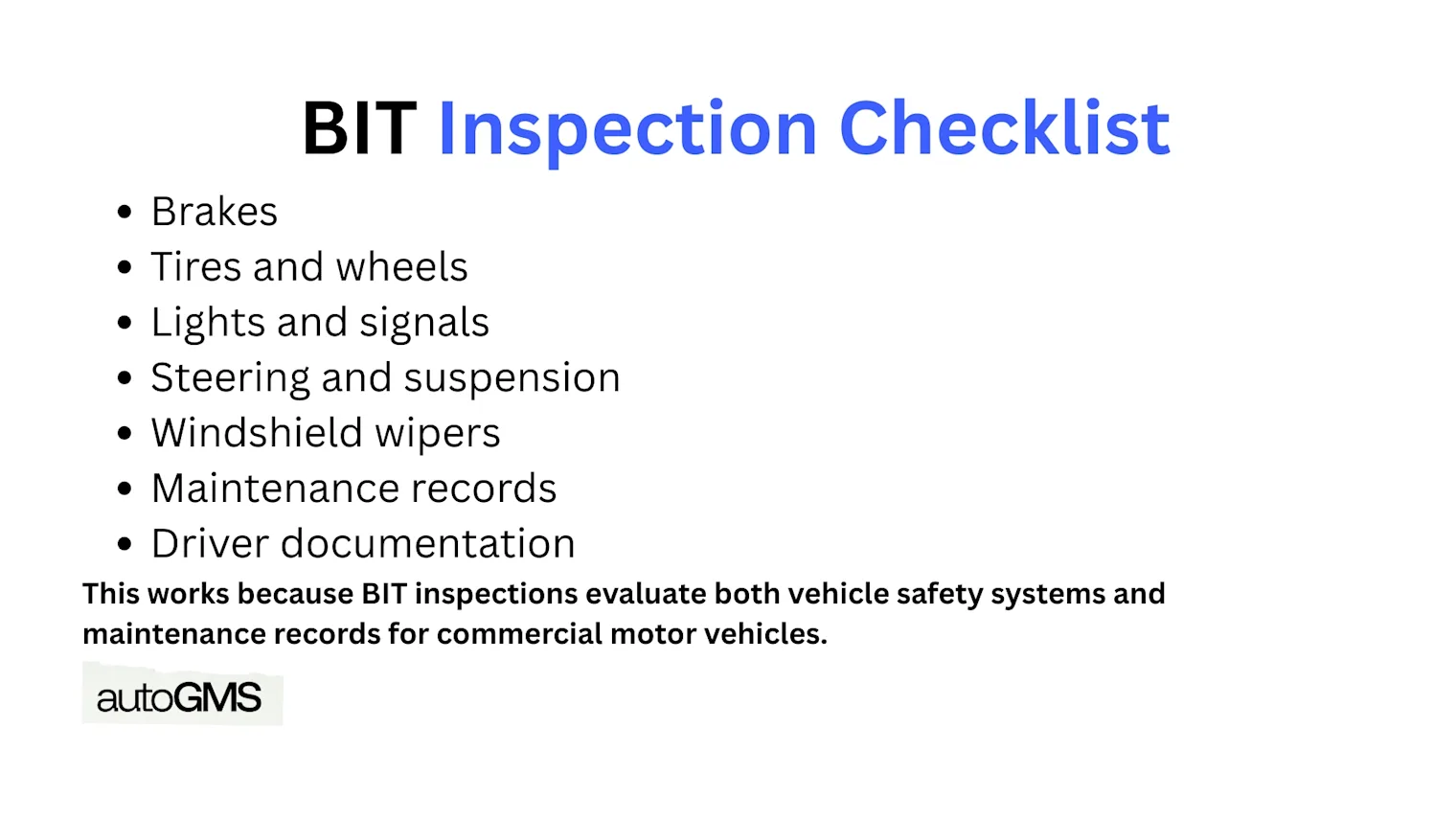
Vehicle Code 34505.5 sets five minimum items for every 90-day inspection. The CHP's own form for this inspection, the CHP 108 (Truck and/or Tractor Maintenance & Safety Inspection), adds the rest of the vehicle. You can use the CHP 108 or your own form, as long as it covers these items and records the date, the vehicle and any repairs.
| Area | What to check | Required minimum? |
| Brake adjustment | Push-rod stroke or slack adjuster travel on every axle | Yes |
| Brake system | Lines, hoses, chambers, drums or rotors, linings, air or fluid leaks | Yes |
| Steering and suspension | Steering play, linkage, springs, hangers, U-bolts, air bags | Yes |
| Tires and wheels | Tread depth, cuts, bulges, inflation, rims, lug nuts | Yes |
| Connecting devices | Fifth wheel, kingpin, pintle hook, safety chains, glad hands | Yes |
| Lights and reflectors | Headlights, brake lights, turn signals, clearance lights | CHP 108 |
| Cab and driver controls | Mirrors, wipers, horn, gauges, seat belts | CHP 108 |
| Engine and exhaust | Belts, hoses, radiator, battery mounts, exhaust leaks | CHP 108 |
| Fuel system | Tank mounts, caps, lines, leaks | CHP 108 |
| Frame and undercarriage | Cracks, loose or missing fasteners, body mounts | CHP 108 |
Any defect found has to be fixed before the vehicle goes back into service, and the repair belongs on the same record. That repair note is often the first thing an officer looks for.
What happens during a CHP terminal inspection
CHP selects the terminal. Terminals are prioritized by safety performance, using roadside inspection and crash data from the FMCSA's Safety Measurement System.
The officer reviews maintenance records. Expect to show every 90-day inspection report from the last two years, plus repair orders and invoices.
The officer reviews driver records. Typical requests include driver licenses, medical certificates, hours-of-service records and drug and alcohol testing records.
The officer inspects a sample of vehicles. The trucks and trailers in the yard are checked against the same items as your 90-day checklist.
The terminal gets a rating. A satisfactory rating closes the inspection. An unsatisfactory rating comes with written direction on what to fix and a re-inspection within 120 days.
BIT inspection vs DOT inspection
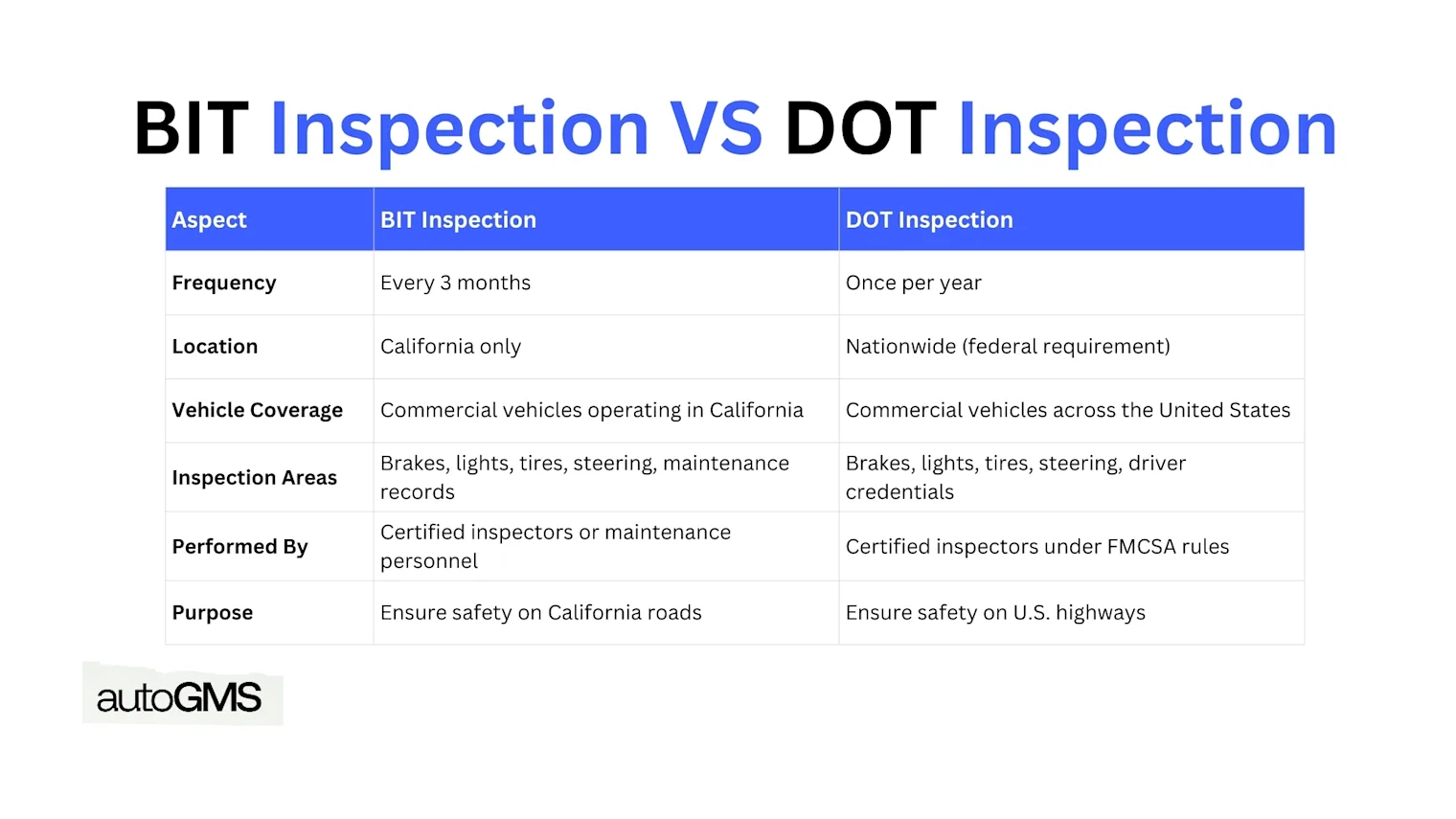
| BIT inspection (California) | DOT annual inspection (federal) | |
| Set by | California Highway Patrol, California Vehicle Code | FMCSA, 49 CFR 396.17 |
| Applies to | Covered vehicles of California motor carriers | Commercial motor vehicles in interstate commerce |
| Carrier's inspection | Every 90 days, per vehicle | At least once every 12 months, per vehicle |
| What gets checked | Vehicles, maintenance records and driver records at the terminal | The vehicle, against the federal inspection standard |
| Who can inspect | The carrier's mechanics or a repair shop | A qualified inspector: State-approved training or at least one year of relevant experience (49 CFR 396.19) |
| Inspection records | Kept at the terminal for 2 years | Annual inspection report kept for 14 months (49 CFR 396.21) |
The two don't replace each other. Many fleets line up one of the four 90-day inspections with the annual DOT inspection, done by a qualified inspector to the federal standard, so one shop visit covers both.
Records to keep for a BIT inspection
| Record | How long | Rule |
| 90-day inspection reports | 2 years, at the terminal | California Vehicle Code 34505.5 |
| Annual DOT inspection report | 14 months | 49 CFR 396.21 |
| Maintenance and repair records | 1 year, plus 6 months after the vehicle leaves your control | 49 CFR 396.3 |
| Driver vehicle inspection reports (DVIRs) | 3 months | 49 CFR 396.11 |
How to prepare for a BIT inspection
List every covered vehicle. Include unit number, VIN, GVWR and the date of its last 90-day inspection.
Book inspections at around 80 days. That leaves room for parts delays without missing the 90-day limit.
Close every defect on paper. Each defect should show the repair, the date and who did it.
Keep records where CHP can see them. Reports have to be available at the terminal, on paper or digitally.
Check driver files. Make sure licenses and medical certificates are current and hours-of-service records are complete.
Run a mock audit. Pull five random vehicles and check that their last two years of 90-day reports are complete.
How repair shops can handle BIT inspections for fleet customers
Every covered truck needs four inspections a year, so a fleet customer brings steady, scheduled work. The shops that keep that work are the ones that make the paperwork easy for the carrier.
Track the 90-day date for each vehicle and remind the fleet before it's due.
Use a digital inspection checklist with the five required items, plus photos of anything that fails.
Turn failed items into a job card so the repair is recorded on the same vehicle history.
Send the fleet a complete record after each visit: inspection, repairs and invoice in one place.
autoGMS keeps each vehicle's inspections, job cards and invoices on one service history, with reminders for the next visit. Book an autoGMS demo to see how it handles fleet inspection work, or read our vehicle inspection checklist for auto repair shops and guide to digital vehicle inspections.
Sources
CHP 800H: The Basic Inspection of Terminals (BIT) Program, California Highway Patrol
CHP 108: Truck and/or Tractor Maintenance & Safety Inspection form, California Highway Patrol
AB 3278 (2024), Transportation omnibus bill, California Legislature
Frequently asked questions
What does BIT stand for?
BIT stands for Basic Inspection of Terminals. It is a California Highway Patrol program that inspects motor carrier terminals, including a sample of vehicles, maintenance records and driver records. It was originally called the Biennial Inspection of Terminals.
How often is a BIT inspection required?
The carrier must inspect each covered vehicle at least every 90 days. CHP inspects the terminal itself based on the carrier's safety performance, and after a satisfactory rating it is not required to return for up to six years.
Which vehicles need 90-day BIT inspections?
Since AB 3278, the 90-day rule covers trucks with three or more axles over 10,000 lb, commercial vehicles with a GVWR of 26,001 lb or more, truck tractors, vehicles towing a trailer rated over 10,000 lb, the trailers they pull and placarded hazmat vehicles. Check two-axle trucks between 10,001 and 26,000 lb with the CHP.
What vehicles are subject to BIT inspections?
Commercial vehicles with a gross vehicle weight rating (GVWR) above 10,000 pounds, certain passenger vehicles designed to transport more than 10 people, and vehicles carrying hazardous materials are typically subject to BIT inspections in California.
Does a BIT inspection replace the annual DOT inspection?
No. The 90-day inspection is a California requirement and the annual inspection is a federal one. Many fleets have one of their 90-day inspections done by a qualified inspector to the federal standard so it also counts as the annual inspection.
How long do you keep 90-day inspection records?
Keep 90-day inspection records at the terminal for two years. Federal rules also require keeping the annual inspection report for 14 months and driver vehicle inspection reports for three months.
What happens if you fail a BIT inspection?
The terminal gets an unsatisfactory rating, CHP gives written direction on what to correct, and the terminal is re-inspected within 120 days.
How much does a BIT inspection cost?
CHP stopped charging fees for BIT terminal inspections on January 1, 2016. The cost is the 90-day inspections themselves, which repair shops price by vehicle type and the repairs needed.